
Algorithmic Trading: What It Is and How to Start (Without Being a Programmer)
Need More Help? Book Your FREE Strategy Session With Our Team Today!
We’ll help you map out a plan to fix the problems in your trading and get you to the next level. Answer a few questions on our application and then choose a time that works for you.
Algorithmic trading means running a trading system according to explicit, pre-written rules — rules that tell a computer when to buy, when to sell, and how much risk to take. The computer executes those rules automatically. No guessing, no emotion, no watching charts all day. You define the logic once; the system runs it. This guide explains how it works, whether it actually delivers results, and how to go from zero to a running trading system — without needing to write code.
What is algorithmic trading?
Algorithmic trading is the practice of executing trades based on a defined set of rules that a computer applies automatically. The “algorithm” is just the ruleset: a structured sequence of if-then conditions built from price data, indicators, time filters, or any other measurable input.
A simple example: “If the 50-day moving average crosses above the 200-day moving average on a daily chart, and today’s volume is above average, enter a long position with a stop-loss at 2% below entry.” That rule can be coded, tested on historical data, and automated so it fires every time conditions are met — while you are at work, asleep, or on holiday.
Algorithmic trading is not a magic machine. It is a disciplined process for turning a market hypothesis into a testable, repeatable system. The advantage over discretionary trading is consistency: the system applies the same rule every time, without second-guessing.
Algorithmic vs automated vs systematic trading
These three terms overlap, and traders use them interchangeably. Here is how to separate them:
- Systematic trading is the broadest category. It means following explicit rules rather than gut feel. A systematic trader could manually execute their rules — no computer required.
- Algorithmic trading means those rules are expressed as an algorithm: a coded, machine-readable instruction set.
- Automated trading means the algorithm also executes the orders without human intervention. The system detects the signal and sends the order to the broker directly.
In practice, most people use “algorithmic trading” to mean all three at once: rules-based, coded, and automated. That is the usage in this article. The important distinction is between this approach and discretionary trading — decisions made case-by-case, based on judgment and intuition. You can read a direct comparison of the two in our piece on discretionary vs systematic trading.
Does algorithmic trading actually work?
The honest answer: yes, for traders who approach it as a serious discipline. No, for traders who expect the algorithm to do the thinking for them.
Algorithmic trading works when:
– The underlying trading rules capture a real, repeatable edge in the market (not a coincidence that looked good in past data)
– The system is tested rigorously before going live, and the backtest results are realistic
– Risk is managed carefully — position sizing, stop-losses, and portfolio-level exposure limits are built in from the start
– The trader monitors the system and knows when a drawdown (a temporary decline in account equity) is within expected range versus when something has broken
Algorithmic trading does not work when:
– The rules are tuned to fit past data perfectly but fall apart on live markets (called overfitting — more on this below)
– The system runs unchecked with no risk controls
– Expectations are set around “the bot will make me rich” rather than “this system has a positive expectancy over hundreds of trades”
Expectancy is the average amount a trading system wins or loses per trade, calculated across a large sample. A system with positive expectancy earns more on its winning trades than it loses on its losers — even if it loses the majority of the time. That is the mathematical foundation. The rest is execution and discipline.
Institutional traders, hedge funds, and quantitative firms have used algorithmic trading profitably for decades. The same principles are accessible to individual traders — but the work required to build a solid trading system is real. There is no shortcut.
Do you need to code? The no-programmer path
This is the most common barrier traders report: “I am interested in algorithmic trading but I cannot code.” The barrier is real but not as high as it seems.
Today, platforms such as MultiCharts and TradeStation make it possible to develop trading systems without having to start from scratch. Thanks to languages like PowerLanguage and EasyLanguage, along with the many code examples, templates, and libraries already available, traders with programming skills can customize every aspect of a strategy, while those without coding experience can still begin with proven models and adapt them to their own needs.
There are also tools such as the Million Dollar Database – our collection of top-performing strategies developed by our students and made available as part of our educational programs – that provide access to fully coded strategies that can be used even without any programming knowledge.
The deeper point: coding is the implementation step, not the thinking step. The hard intellectual work in algorithmic trading is defining your rules clearly enough that they could be coded — by you or by someone else. A trader who can articulate “enter long when X, exit when Y, stop-loss at Z, maximum 2% of portfolio per trade” has done 80% of the job. The translation into code is a learnable technical skill — not a prerequisite for the trading logic itself.
The Unger Method, developed by world trading champion Andrea Unger, is built on exactly this premise: a rules-based, structured path to building trading systems that does not require a computer science background. Define the rules first. The code follows.
How to start: rules → backtest → automate
The path from idea to running trading system has three phases. Each phase has a clear output. Do not skip ahead.
1. Turn a strategy into explicit rules
Most traders have trading ideas. Far fewer have trading rules. An idea sounds like: “I want to trade breakouts.” A rule sounds like: “If today’s close is above the highest high of the past 20 days, and the ATR (Average True Range, a measure of recent volatility) is below the 30-day ATR average, enter long at the next open. Exit at the close of the 10th day or at a 3% stop-loss, whichever comes first.”
The test for a rule is simple: could you hand it to someone who knows nothing about trading and have them apply it mechanically, without interpretation? If yes, it is a rule. If it requires judgment — “enter when the chart looks strong” — it is still an idea.
Rules must cover: entry condition, exit condition (target and stop-loss), position size, and any filters (time of day, market conditions, instrument-specific constraints).
Write them in plain language first. Every word matters. Ambiguity in the rule description becomes unpredictable behavior in the code.
2. Backtest on historical data
Backtesting means running your rules against historical data to see how the system would have performed in the past. Most trading platforms have built-in backtesting engines. You define the rules, select a historical dataset (at minimum 5–10 years of data, covering different market regimes), and let the platform simulate every trade the system would have taken.
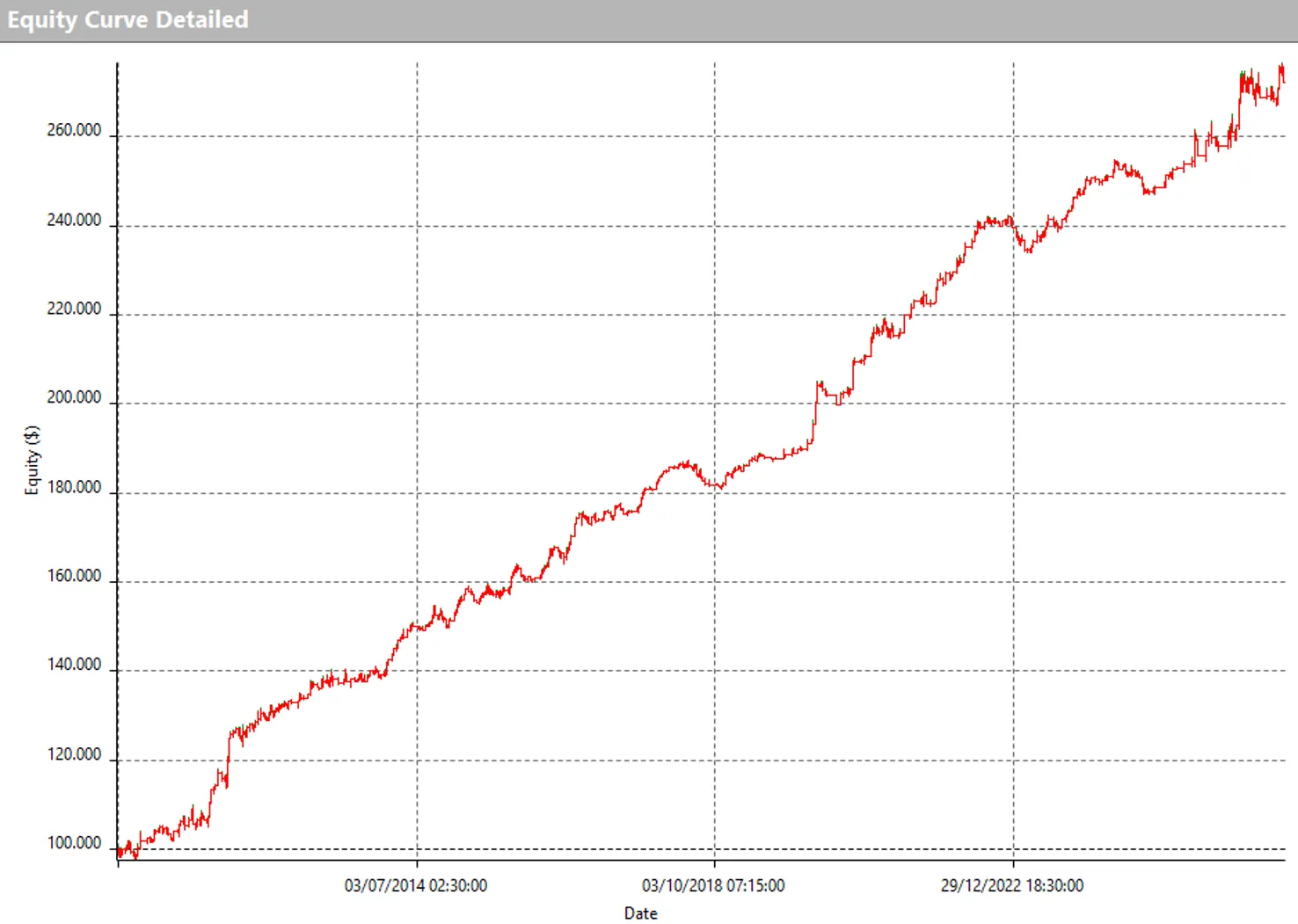
The output is a performance report: total return, win rate, average win versus average loss, maximum drawdown (the largest peak-to-trough equity decline in the period), and expectancy.
Two critical warnings:
Overfitting is the most common and most dangerous mistake in backtesting. It means optimizing rules so tightly to past data that the system essentially memorizes historical patterns rather than capturing a real edge. An overfitted system shows spectacular backtest results and terrible live results. Signs: very high win rate (above 70–80%), near-zero drawdown, rules with many precise parameters. The fix is to test on out-of-sample data — a portion of historical data the system was never trained on — and to keep rules simple.
Realistic costs must be included: commissions, slippage (the difference between your expected entry price and actual fill price), and any spread. A system that looks profitable ignoring costs often does not survive once they are added.
A backtest that passes with realistic costs and out-of-sample validation is the minimum bar before moving to the next step.
3. Automate execution and manage risk
Automation means connecting the coded rules to a live brokerage account so orders fire automatically when conditions are met. On MetaTrader, this is done via Expert Advisors (EAs). Other platforms use different terminology but the concept is identical.
Before running live, paper trading (simulated trading with real market data but no real money) is a useful intermediate step. It confirms the system behaves as expected in real market conditions — with real spread, real data feeds, real execution latency — before capital is at risk.
Live automation is not set-and-forget. A running trading system needs regular monitoring: checking that it is executing correctly, reviewing whether live performance matches backtest expectations, and adjusting position size if account equity changes significantly. A good systematic trading approach always defines what “normal drawdown” looks like for the system, so you know when to pause versus when to hold the course.
Portfolio-level risk management applies here too. Running multiple uncorrelated trading systems across different instruments and timeframes reduces the impact of any single system’s bad period. Diversification in algorithmic trading means diversification of system logic, not just assets.
Common mistakes
Building too complex a system. More rules do not mean better performance. They usually mean more overfitting. The most solid trading systems tend to have simple, intuitive logic.
Skipping walk-forward validation. Testing only on the same data you used to develop the rules is like studying the exam answers and calling it learning. Always reserve a portion of data you have never touched for out-of-sample testing.
Ignoring drawdown expectations. Every trading system has drawdowns. Without modeling what a realistic drawdown looks like for your system, you will almost certainly pause the system at the worst possible moment — during a temporary slump that falls within normal range.
Chasing past performance. A system that performed well in 2020–2021 (high-volatility, trending markets) may perform very differently in a mean-reverting, low-volatility environment. Market regimes change. Systems need to be matched to the conditions they were built for, or built to be regime-agnostic.
Underestimating execution costs. This particularly affects short-term systems that trade frequently. A high-frequency trading system can generate excellent gross returns and negative net returns once costs are factored in.
Running a single system. A portfolio of uncorrelated trading systems is more solid than a single system, no matter how good that single system looks. Correlation matters — two systems that both go long on trending markets are not diversified.
Is algorithmic trading right for you?
Algorithmic trading suits traders who prefer analytical, rules-based work over real-time decision-making. It rewards patience in the development phase and discipline in the live phase.
It is a good fit if:
– You want a trend following trading system or other rules-based approach that runs without constant monitoring
– You have time to invest in learning the methodology — not just the tools
– You are comfortable with months of flat or negative performance as part of any system’s lifecycle, not signs of failure
– You want to allocate a few hours per week to monitoring and improvement rather than active trading hours
It also requires a realistic commitment:
– Learning the methodology properly takes weeks to months
– Building and validating a single trading system takes meaningful effort — typically more than beginners expect
– Results take time to evaluate statistically — judging a system on 20 trades is not enough data
This is not a path to overnight wealth. It is a structured approach to building something that can generate consistent results over time, with quantifiable risk. That distinction matters.
If your goal is a system that runs with minimal daily involvement and produces consistent, data-driven results — this is the right direction.
FAQ
What is algorithmic trading?
Algorithmic trading is trading based on explicit, pre-written rules that a computer executes automatically. The rules define when to enter and exit trades, how much to risk, and any filters to apply. The computer applies these rules consistently, without emotion or interpretation.
Does algorithmic trading really work?
Yes, when approached as a serious discipline. Professional traders, hedge funds, and quantitative firms have used it profitably for decades. For individual traders, it works when the underlying rules capture a real edge, the system is properly backtested and validated, and risk management is built in from the start. It does not work when expectations are unrealistic or the system runs without oversight.
Do you need to be a programmer to do algorithmic trading?
No, though basic scripting skills help. Trading platforms like MultiCharts use scripting languages that are learnable without a programming background. The harder work is defining your trading rules clearly in plain language — if you can do that, the coding step is a technical skill you can learn or outsource.
Is algo trading legal?
Yes, algorithmic trading is legal in all major markets. Regulations vary by jurisdiction and broker, so it is worth confirming that your broker allows automated trading and understanding any applicable rules for the market you trade. Retail algorithmic trading is entirely standard practice.
How much money do algorithmic traders make?
There is no single honest answer. Results depend on the system, the capital deployed, the market conditions, and the risk level taken. Professional quantitative traders at institutions can earn substantial returns, but they also have infrastructure, data, and risk controls that individual traders do not. Individual retail algo traders show highly variable results: some build consistently profitable systems; many do not. A well-built, validated trading system can reasonably aim for a risk-adjusted return that outperforms a passive benchmark over a multi-year period — not a guaranteed monthly income.
Interested in building your first trading system with a proven methodology? Join a free strategy session with the Unger Academy team to explore whether systematic trading fits your goals.
Transcription
Need More Help? Book Your FREE Strategy Session With Our Team Today!
We’ll help you map out a plan to fix the problems in your trading and get you to the next level. Answer a few questions on our application and then choose a time that works for you.