
Automated Trading: Why a Perfect Backtest Can Fail in Live Markets
Need More Help? Book Your FREE Strategy Session With Our Team Today!
We’ll help you map out a plan to fix the problems in your trading and get you to the next level. Answer a few questions on our application and then choose a time that works for you.
An automated trading system can deliver excellent backtest results and then start losing money as soon as it is deployed with real capital. In many cases, the problem is not the platform or the broker, but the way the system was built, optimized, and validated.
Andrea Unger understands the difference between historical results and live performance. He is a four-time winner of the World Cup Trading Championships, a competition conducted with real money, and has been developing trading systems for more than 25 years.
His experience shows that one of the most common mistakes among people approaching automated trading is trusting a seemingly perfect backtest without verifying whether the system is truly robust.
Understanding where the problem may be hiding is the first step toward preventing promising historical results from turning into losses in live markets.
What Is Automated Trading?
Automated trading involves executing buy and sell orders in financial markets according to predefined rules, without manual intervention when a signal occurs.
For example, a system might open a position when the price meets certain conditions and close it when a different set of rules is triggered. The software automatically executes the trades whenever those conditions are met, without requiring the trader to constantly watch the screen and intervene manually.
The original idea may come from observation or from the trader’s discretionary experience. Once it has been converted into objective rules, coded, and mechanically applied to historical data, however, it becomes testable, repeatable, and verifiable.
This is one of the fundamental principles of systematic trading: decisions are not made individually based on emotions or intuition, but according to criteria established in advance.
Are Automated Trading and Algorithmic Trading the Same Thing?
The two terms are often used interchangeably and tend to overlap in the everyday language used by brokers and trading platforms.
Broadly speaking, algorithmic trading involves the use of algorithms that automatically determine certain order parameters, such as whether to initiate an order, when to execute it, its price and quantity, or how it should subsequently be managed.
The term “automated trading,” on the other hand, is commonly used to describe a system that manages the entire process, from signal generation to execution, with limited or no human intervention.
In any case, the terminology does not determine whether a system can work. What matters is how the system was built, tested, and subsequently managed.
The Problem a Backtest Does Not Reveal at First Glance: Overfitting
What Happens When a System Works Well Only on Historical Data
Overfitting is one of the most underestimated risks in automated trading.
It occurs when a system contains so many parameters and specific conditions that it adapts almost perfectly to the historical data used during development, without capturing a sufficiently stable market behavior.
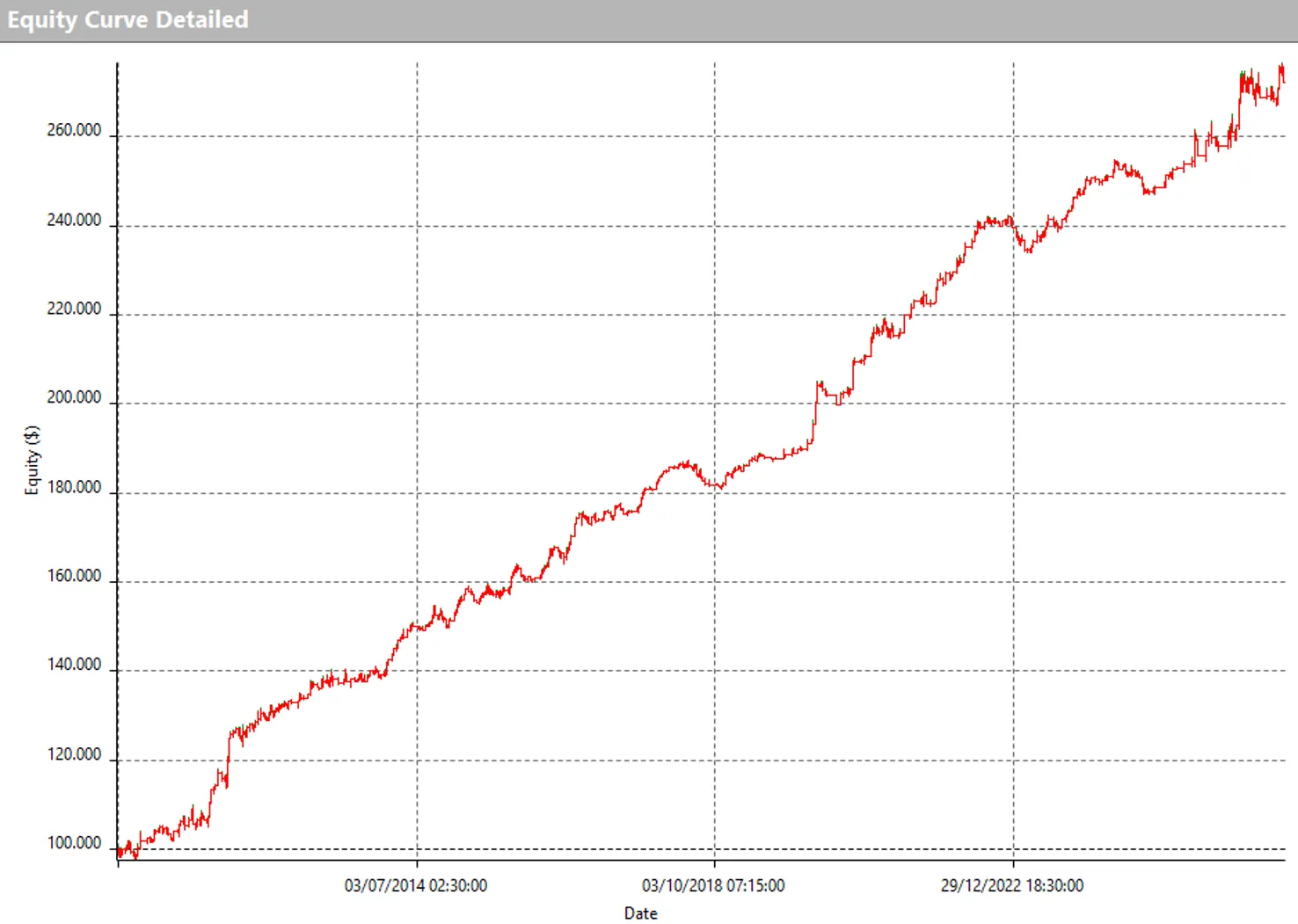
A typical example involves adding one filter after another until the backtest equity curve becomes almost perfectly smooth.
The problem is that the curve describes the specific past the system has already analyzed very well, but not necessarily what will happen in the future.
The system may have identified coincidences and random features in the data rather than a sufficiently robust market logic. As a result, its performance may deteriorate dramatically when it is applied to new data or traded with real capital.
An exceptionally smooth historical equity curve is not necessarily a sign of quality. In some cases, it may be the result of excessive optimization.
Also read: Why Do Perfect Trading Strategies Fail Live? The Problem of Overfitting
Walk-Forward Testing: How to Evaluate a System on Previously Unseen Data
Walk-forward testing is one of the methods used to determine whether a system can maintain a certain level of effectiveness outside the sample on which it was developed.
Historical price data is divided into consecutive segments. The system is calibrated on an initial segment, known as the in-sample period, and then tested without further changes on the immediately following segment, known as the out-of-sample period.
The process is then repeated by progressively moving the time windows forward.
If the system continues to produce consistent results on data that was not used for calibration, this provides a positive indication of its ability to perform under conditions different from those on which it was developed.
However, this does not guarantee that the system will continue to work in the future. Walk-forward testing is an important validation method, but it should be combined with additional robustness tests.
A backtest limited to the sample used for development, no matter how attractive its equity curve may appear, provides much weaker evidence of the system’s ability to remain effective in the future.
How Andrea Unger Builds and Validates an Automated Trading System
Andrea Unger’s approach generally begins with a simple idea, which is then translated into objective rules that can be coded and tested. Before being considered for live trading, the system is tested on historical data and subjected to out-of-sample testing and robustness analysis.
If it loses effectiveness outside the sample used for development, it is discarded or revised, regardless of how promising it appeared in the initial backtest.
The goal is not to produce the most attractive historical equity curve possible, but to determine whether the results are supported by a sufficiently stable logic that may continue to work under different market conditions.
Simplicity also plays an important role. A system with a small number of clear rules and an understandable rationale may be easier to validate than a strategy made up of numerous filters, exceptions, and optimized parameters.
Verifying before trusting the results helps distinguish a potentially robust system from one that has simply adapted to the past.
Why Live Markets Are Different From Backtests
Even a properly constructed backtest cannot perfectly reproduce every condition that a system will encounter in live markets.
Live execution involves factors such as commissions, slippage, liquidity, order transmission delays, connection issues, and differences between the theoretical price and the price actually obtained.
These factors can have a significant impact on performance, especially for systems that execute a large number of trades or have a relatively low average profit per trade.
For this reason, a realistic backtest should include transaction costs and conservative execution assumptions. Before increasing exposure, it may also be useful to observe the system’s behavior in simulation or begin trading it with a limited amount of capital.
Moving into live trading is therefore not a mere formality, but an additional stage of the validation process.
What Are the Benefits and Risks of Automated Trading?
Automated trading does not eliminate risk, but it can offer several advantages over discretionary trading.
First, it allows trades to be executed according to predefined rules, without letting fear, euphoria, or indecision interfere with individual decisions. A system can also monitor markets and execute signals quickly and accurately, without requiring the trader to remain in front of a screen throughout the day.
Automation also makes it possible to apply the same rules consistently, analyze a larger number of markets, and manage multiple strategies simultaneously. This can facilitate the construction of a diversified portfolio and make trading more compatible with the schedules of people who cannot follow the markets all day.
These benefits, however, depend on the quality of the system and the process used to develop it. A poorly tested or inadequately monitored system can generate losses quickly because it executes trades mechanically, without questioning the instructions it has been given.
There are also technical and operational risks, including connection failures, coding errors, inaccurate data, duplicate orders, and differences between the platform’s expected and actual behavior.
Automating trading does not mean completely abandoning the system. Instead, it shifts the trader’s work away from making decisions in front of the market and toward development, validation, monitoring, and risk management.
When built and monitored correctly, automated trading can make execution more disciplined, consistent, and efficient. However, it cannot eliminate market fluctuations or guarantee future results.
The Mistake Unger Sees Most Often Among Beginners
People who are new to automated trading often focus on the wrong thing.
They may search online for the “best trading system” to copy or spend weeks fine-tuning the parameters of a single backtest instead of learning the process needed to determine whether a system has sufficiently solid foundations.
The problem is not simply that the copied system might fail. Without understanding how a strategy was built and validated, it becomes difficult to distinguish a potential statistical edge from a system that has merely adapted to past data.
A rigorous development process should include at least the following steps:
- Start with an idea supported by a clear and understandable rationale.
- Translate it into objective rules.
- Test it on a sufficiently large historical sample.
- Account for commissions, slippage, and realistic execution conditions.
- Conduct out-of-sample tests and robustness analyses.
- If appropriate, begin live execution with limited exposure.
- Monitor the system’s behavior over time.
Skipping any of these steps in an attempt to move faster is one of the reasons a seemingly promising system may begin losing capital after it is deployed.
In automated trading, the quality of the process therefore matters much more than the search for an apparently perfect strategy.
Frequently Asked Questions
What Is the Best Automated Trading System?
There is no single software platform or strategy that is best in every situation.
Different systems may be suitable for different markets, amounts of capital, and objectives. More importantly, development and validation processes can vary considerably in terms of rigor.
Before evaluating an automated strategy, it is important to understand which data it was tested on, how costs and slippage were accounted for, and which out-of-sample and robustness tests were conducted.
How Much Can You Make With Automated Trading?
There is no guaranteed amount, and being skeptical of anyone promising certain results is a fundamental rule.
Performance depends on the characteristics of the system, the capital deployed, the level of risk assumed, transaction costs, and market conditions.
Even a positive backtest or a track record obtained with real capital does not guarantee that the same performance will be repeated in the future.
Is Automated Trading Legal?
In general, retail traders can use automated systems provided that they trade through an authorized intermediary and comply with applicable regulations, the broker’s terms and conditions, and the rules governing the instruments being traded.
It is therefore important to verify that the broker and trading platform allow the chosen type of automation.
The ability to use an automated system does not mean that trading is risk-free. Capital remains exposed to market fluctuations as well as potential technical and operational issues.
Does a Good Backtest Guarantee That a System Will Work?
No. A backtest evaluates how a system would have performed on historical data, but it cannot guarantee future results.
It can provide useful information when it is constructed realistically, avoids excessive optimization, and is supported by out-of-sample testing and robustness analysis.
Transcription
Need More Help? Book Your FREE Strategy Session With Our Team Today!
We’ll help you map out a plan to fix the problems in your trading and get you to the next level. Answer a few questions on our application and then choose a time that works for you.