
In this article, we’ll examine two Trend Following strategies developed for Coffee Futures, one of the markets within the soft commodities sector.
Trend Following strategies are designed to capitalize on directional market moves by entering positions once price begins to show strength and remaining in the trade as long as the trend persists. Rather than trying to predict market tops or bottoms, the goal is to participate in established directional moves and capture as much of the trend as possible.
Coffee Futures are a unique market and are often overlooked by systematic traders, who typically focus on more widely traded markets such as the Nasdaq, the S&P 500, Gold, or Crude Oil. Yet the very nature of Coffee Futures, characterized by large and often sustained directional moves, can provide excellent opportunities for well-designed Trend Following strategies.
Although the two systems presented in this article differ in their holding period and trade management, they share the same underlying philosophy. Together, they also illustrate how diversification can be achieved not only across different markets, but even within the same family of trading strategies.
Coffee Futures Trading Strategy #1: Trend Following with a Three-Session Breakout
The first strategy we’ll examine is an intraday Trend Following system applied to Coffee Futures.
The core idea is to capture directional moves following a period of relatively low price volatility. In other words, the strategy does not enter the market randomly. Instead, it waits for a specific market environment to develop, including a period of price compression and favorable volatility conditions. Only when these requirements are met is the system allowed to look for a trade in the direction of the emerging move.
The entry logic is straightforward. The strategy enters long when price breaks above the highest high of the previous three sessions, or enters short when price breaks below the lowest low of the previous three sessions. As mentioned earlier, this is a classic Trend Following approach designed to join a move that is already showing directional strength rather than trying to anticipate it.
Of course, the system relies on more than just the breakout itself. Several pattern filters are used to avoid trades during less favorable market conditions, and entries are restricted to a specific trading window. This is particularly important in markets such as Coffee Futures, where liquidity and trading conditions can vary significantly throughout the day.
Trade management is handled through fixed dollar stop losses and profit targets. In addition, if a position remains open near the end of the trading session, the strategy exits the trade before the close, avoiding overnight exposure.
Figure 1 shows an example of a short trade generated by the system. After a period of sideways price action, the strategy enters on a breakout below the lowest low of the previous three sessions and rides the downward move until the profit target is reached.

Performance of the First Strategy: Smooth Equity Curve and an Average Trade Above $147
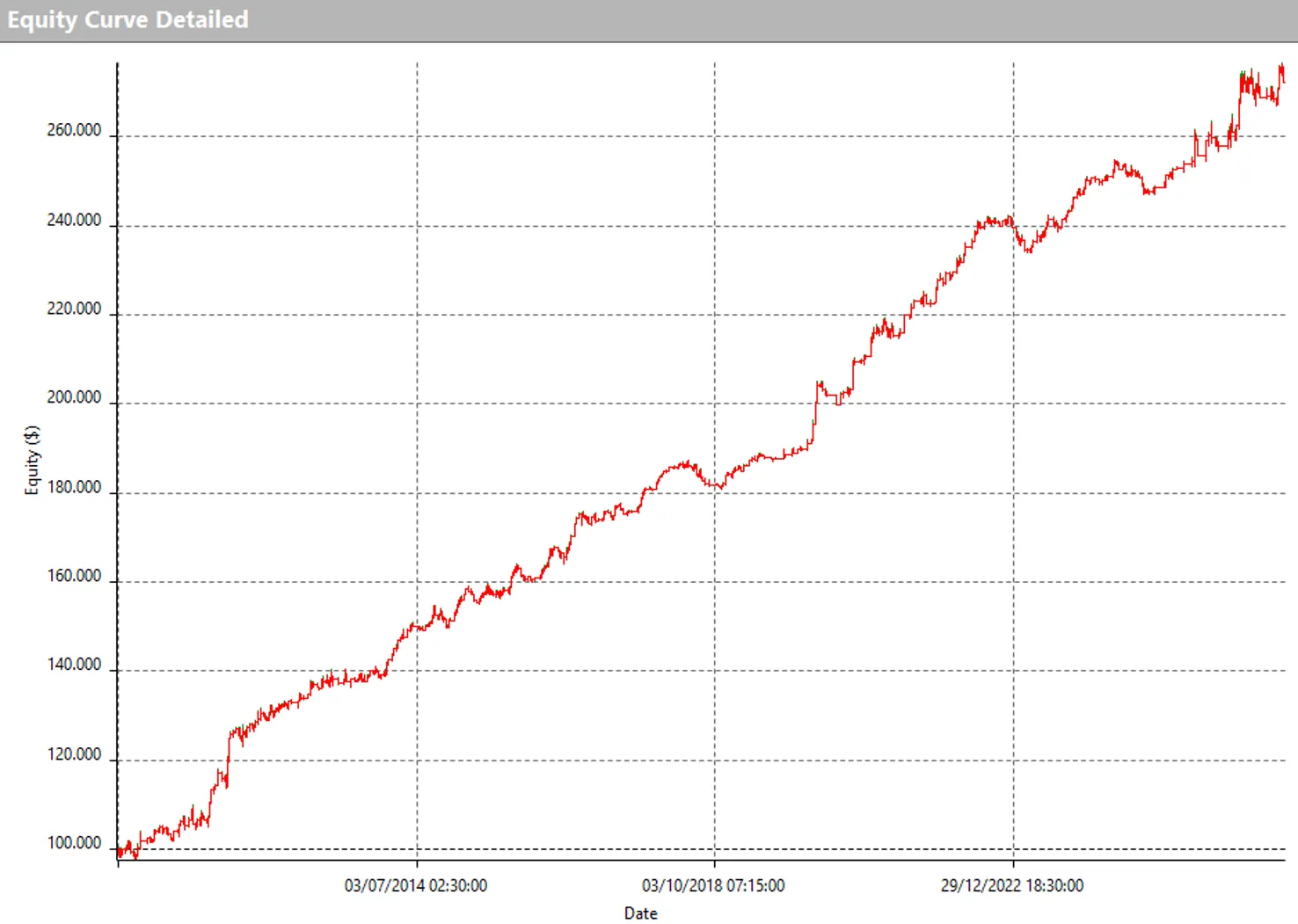
Looking at the strategy’s performance, the first thing that stands out is the quality of the equity curve shown in Figure 2.
The equity curve is remarkably smooth over time, displaying steady growth without prolonged periods of stagnation. This is particularly noteworthy considering that Coffee Futures are far less commonly traded than major equity index futures.
Another positive aspect is the strong run-up recorded during the final portion of the backtest. The strategy accelerated significantly in the most recent years, which correspond to the out-of-sample period, pushing the equity curve to new highs and demonstrating its ability to remain effective under current market conditions.

Figure 3 shows the strategy’s average trade, which is approximately $147 across all trades. Breaking the results down further, the long side produces an average trade of about $167, while the short side generates approximately $134 per trade.
Both long and short trades are profitable, with the long side showing a modest edge in terms of average trade. Overall, the combination of a steadily rising equity curve and a healthy average trade makes this first strategy a compelling candidate for inclusion in a diversified systematic trading portfolio.

Coffee Futures Trading Strategy #2: Multiday Trend Following with Wide Profit Targets
Let’s now move on to the second strategy, also developed for Coffee Futures.
Like the first one, this is a Trend Following strategy designed to capture directional market moves. The main difference is that this system is designed to hold positions for multiple trading sessions, allowing it to capitalize on larger and more sustained trends.
The entry logic begins with a predefined trading window. This is an important aspect of the strategy, as trades can only be initiated during a specific time period rather than at any time throughout the day. Once this condition is met, the system looks at the previous twelve 5-minute bars. A long position is triggered when price breaks above the highest high of this range, while a short position is triggered when price breaks below the lowest low of the previous twelve bars.
As with the first strategy, however, the breakout alone is not enough to generate a trade. Before entering the market, the system checks for additional market patterns and filters designed to identify only the most favorable trading conditions. It also includes day-of-the-week filters to avoid taking trades on days that have historically produced weaker results on either the long or short side.
Trade management is also more flexible than in the first strategy. While the stop loss is still defined as a fixed dollar amount, the profit target is set much farther away in order to capture larger market moves. In addition, the strategy incorporates a breakeven rule that protects the position once the trade has moved sufficiently in the desired direction.
Figure 4 illustrates a typical example. After entering a short position, the system successfully follows an extended bearish trend, holding the trade for several days until the profit target is reached.

Performance of the Second Strategy: New Equity Highs and a $361 Average Trade
The second strategy also delivers an impressive equity curve, shown in Figure 5.
The equity curve rises steadily over time, although it naturally experiences periods of consolidation and temporary drawdowns. One of the most interesting aspects is the final portion of the backtest. After going through a correction phase, the strategy recovered strongly and recently climbed back to new all-time equity highs. This is an encouraging sign, as it demonstrates the system’s ability to adapt to current market conditions.

Figure 6 shows the strategy’s average trade, which is approximately $361 across all trades. This is substantially higher than the first strategy’s average trade of roughly $147.
The difference is consistent with the nature of the system. Because positions are held for a longer period, the strategy aims to capture larger price swings, resulting in significantly higher average profits per trade. Looking at each side separately, the results remain equally attractive, with an average trade of approximately $373 on the long side and about $348 on the short side.
Overall, this second strategy also displays several highly desirable characteristics: a steadily rising equity curve, a recent return to new equity highs, and a particularly strong average trade.

Coffee Futures Trading: Why Soft Commodities Can Strengthen a Systematic Portfolio
As we’ve seen throughout this article, even less popular and less frequently traded markets such as Coffee Futures can offer compelling opportunities when approached with well-designed and robust systematic strategies.
Another key takeaway is the importance of diversification. Diversification can be achieved by trading different markets, but also by combining different trading styles, such as Trend Following and Mean Reversion. As these examples demonstrate, diversification can even take place within the same strategy family, where a faster intraday system can complement a multiday strategy designed to capture larger, longer-lasting market trends.
This type of approach helps build more robust portfolios that are less dependent on the performance of any single trading system.
Moreover, Coffee is just one of the markets within the soft commodities sector. Markets such as Sugar, Cocoa, and Cotton may offer equally interesting characteristics and are well worth further research.
Exploring less crowded markets and developing complementary trading strategies is one of the most valuable aspects of systematic trading and portfolio construction.
If you’d like to learn more about systematic trading, discover the Unger Method™, and see how to develop robust, diversified trading strategies across a wide range of financial markets, you can book a free strategy session with our team using the button below. We’ll be happy to answer your questions and show you our data-driven approach to the markets.
Happy trading, and see you in our next portfolio review! 😉