
The Nasdaq has undoubtedly been one of the standout markets in recent years. For this reason, today we will analyze four different trading strategies designed for the CME-listed Nasdaq futures contract (NQ), a market that continues to offer significant opportunities for systematic traders.
One of the main factors behind Nasdaq’s growing prominence has been the remarkable rise of major technology companies. Some of these firms have already become household names, while others are attracting increasing attention ahead of potential future public listings, such as SpaceX, OpenAI, and Anthropic.
In this article, we will explore four different trading approaches and review their current performance, with the goal of providing practical ideas and inspiration for developing new trading systems on this market.
The strategies belong to the broad family of Trend Following and Breakout systems, which have recently continued to demonstrate their effectiveness through remarkably consistent performance over time.
Nasdaq Trading Strategy #1 – Intraday Breakout
The first strategy we will examine operates on a 15-minute time frame. It is a long-only system that trades breakouts of a volatility channel built using a secondary daily data series (Data2) based on 1,440-minute bars.
The strategy also incorporates several operational filters, including specific price patterns, to identify the most promising trading opportunities.
While the core trading logic is relatively straightforward, it is complemented by a comprehensive risk management framework that includes a Stop Loss, Profit Target, and Trailing Stop.
As this is an intraday strategy, all positions are closed before the end of the trading session unless an exit is triggered earlier by one of the risk management rules.

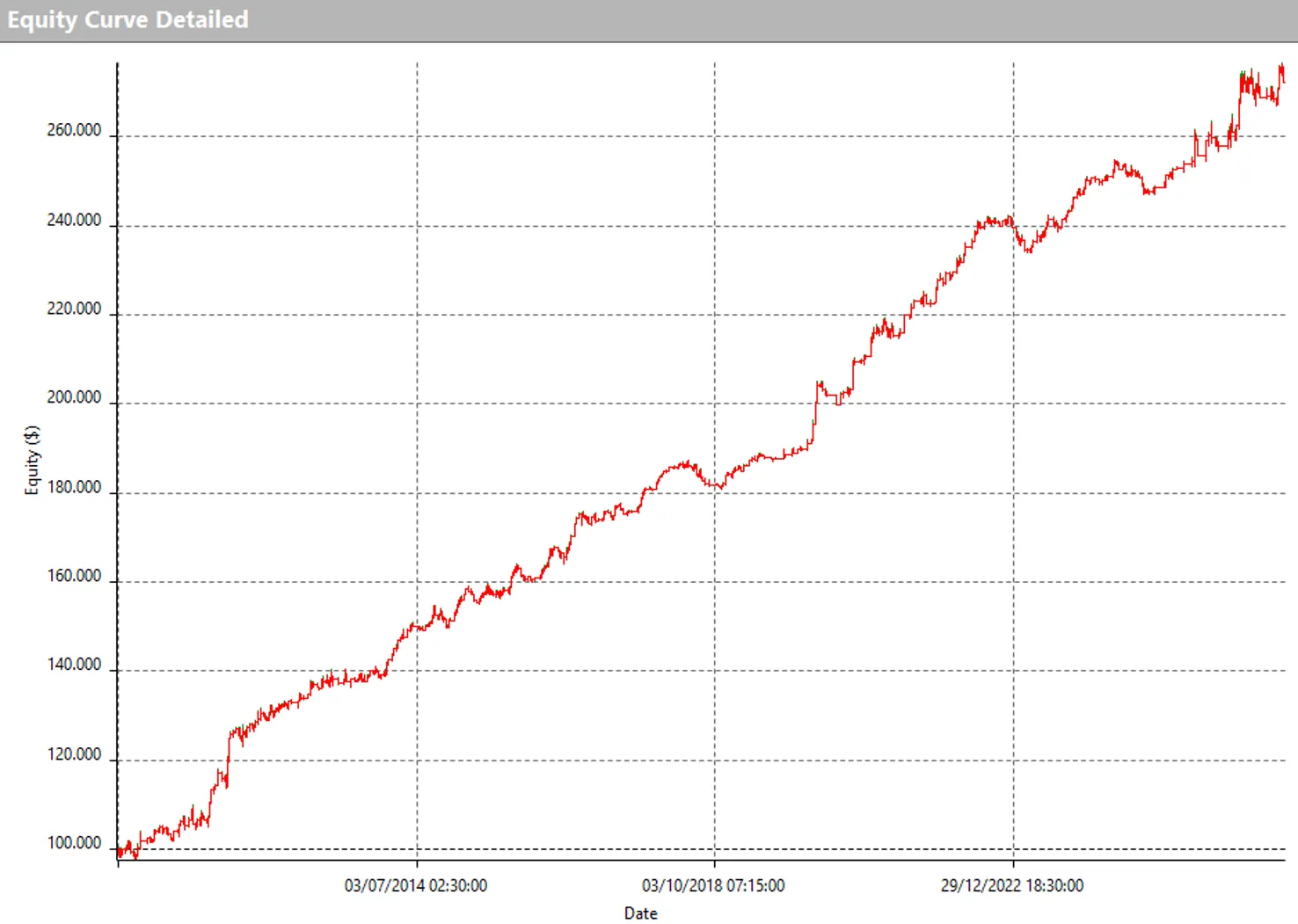
Below, we can observe the strategy’s equity curve, which has displayed remarkably consistent growth from 2016 through today.

As expected, the consistency of the equity curve is also reflected in the annual performance distribution. Every year has closed in profit except for 2017, a year widely remembered for its unusually low volatility and lack of directional movement across many markets – conditions that tend to be challenging for strategies of this type.
The current year is shaping up to be one of the strongest so far, with more than $16,000 in profits generated in less than six months.

Let us now look at the strategy’s key performance metrics, all of which are particularly noteworthy. Among the most impressive figures is an average trade exceeding $280, an excellent value for an intraday trading system. The strategy also maintains a low drawdown considering the volatility and strong directional movements often seen in the Nasdaq futures market. Total Net Profit is approximately $230,000, a significant result especially when considering the system’s limited market exposure and short average holding time.

Nasdaq Trading Strategy #2 – Intraday Trend Following with a Price Channel
Let us now move on to the second strategy. Like the previous one, it is a long-only system, but it operates on a 30-minute time frame. This strategy is built around one of the most widely used and reliable trading concepts: a Price Channel based on the highest highs and lowest lows over a specified lookback period.
As is often the case in systematic trading, the core entry logic is enhanced through additional filters designed to improve trade selection. In this specific case, the strategy uses a volatility filter based on a secondary daily data series (Data2) with 1,440-minute bars. As with Strategy #1, positions are closed at the end of the session if neither the Stop Loss nor the Profit Target has been reached beforehand.
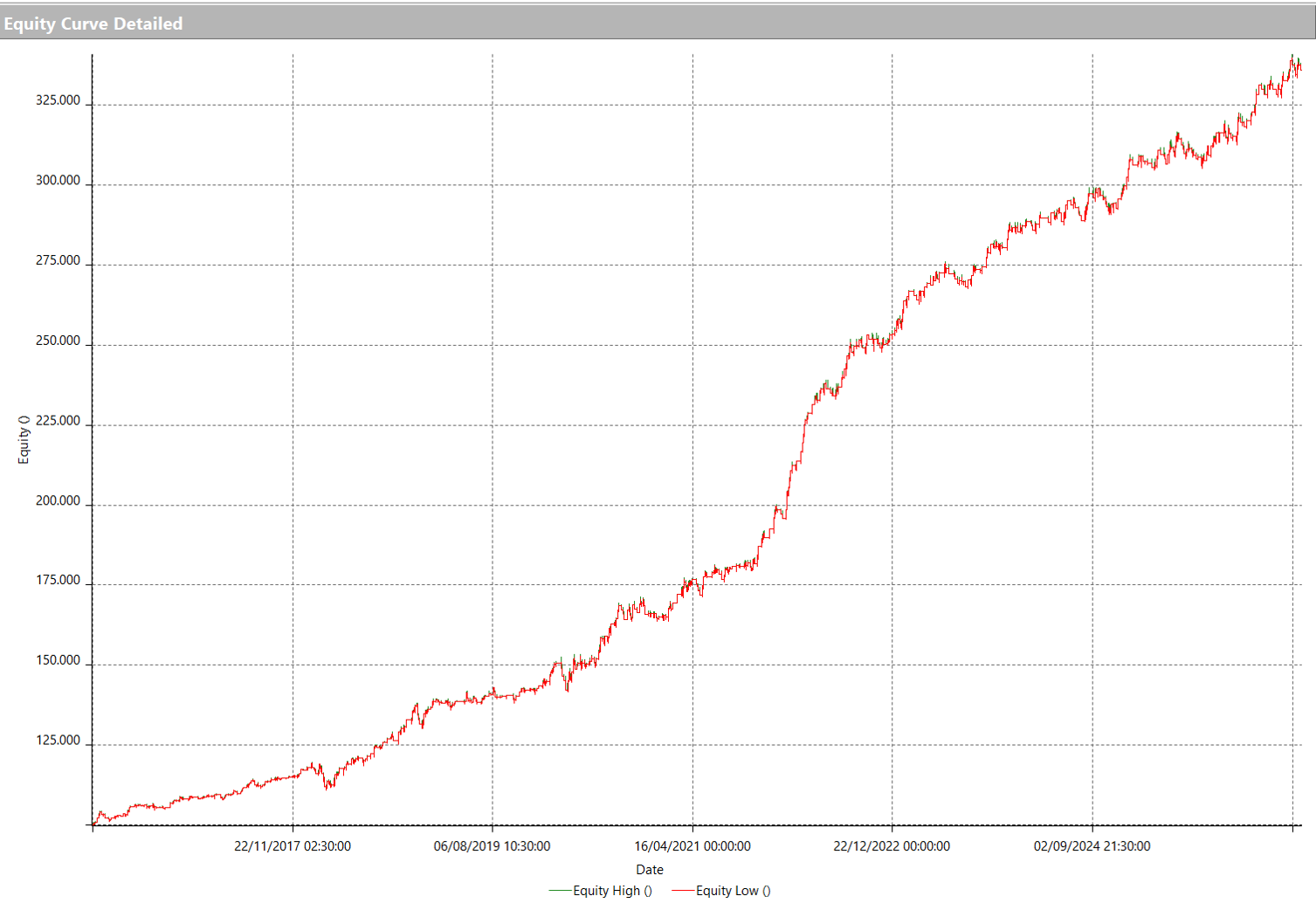
Below we can see an example trade, the equity curve, and the main performance statistics generated by the system.
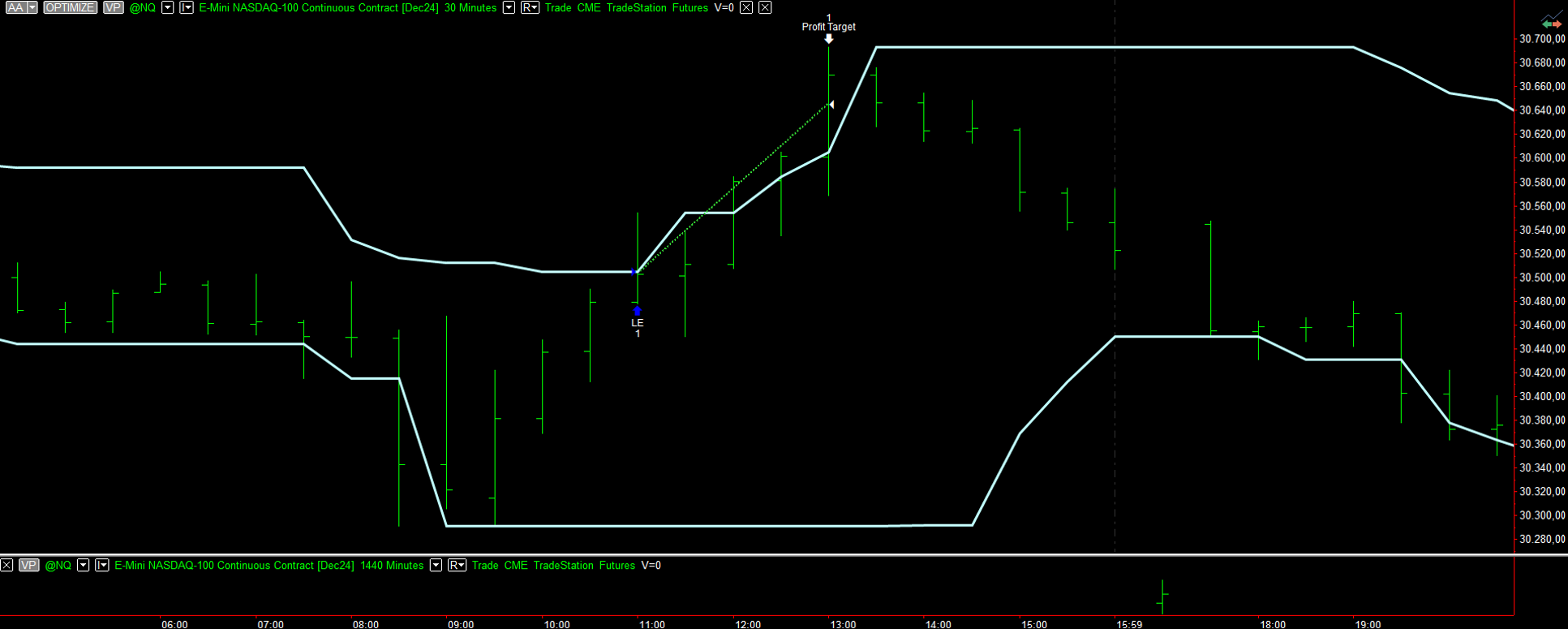
Once again, we are looking at an exceptionally consistent equity curve. Similar to the previous strategy, every single year in the test period closed with a profit, including 2017.

Let us now examine the Total Trade Analysis. The performance metrics are once again quite impressive. The average trade is close to $280, an excellent result for an intraday trading system. Maximum drawdown remains contained at just $11,325, while total Net Profit exceeds $230,000.

Nasdaq Trading Strategy #3 – Trend Following Based on the Previous Session’s Range
The third strategy also follows an intraday approach. It operates on 15-minute bars and closes all positions before the end of the trading session. The core logic uses the opening price of the new session as a reference point to calculate trading levels based on the range recorded during the previous trading day.
As a result, the strategy does not rely on static levels. Instead, it uses dynamic thresholds that automatically adapt to recent market volatility. If the previous session experienced a particularly wide range, the entry levels will be positioned further away from the opening price. Conversely, after a more compressed trading day, the threshold required to generate a signal will be closer to the session open.
Before entering a trade, however, the system does not simply wait for price to break through these levels. Several additional filters are applied to identify specific market conditions and avoid trading during less favorable environments. The strategy also operates within a predefined time window, focusing its activity on the portions of the session considered most attractive from a trading perspective.
Figure 9 shows a practical example of how the strategy works. After an initial period of sideways movement, the Nasdaq begins a strong bullish advance and continues trending higher in a fairly orderly manner. The long signal is generated after the move is already underway, but the strength of the trend still allows the strategy to capture a significant portion of the upside momentum.

Turning to performance, Figure 10 displays the strategy’s equity curve. The overall result is clearly positive, showing meaningful growth over time, although the gains are not distributed evenly throughout the test period. The most recent phase exhibits a particularly strong acceleration, reflecting the powerful directional moves that the Nasdaq has delivered in recent months.

Figure 11 provides a breakdown of the strategy’s key performance statistics. The system generated a total of 616 trades, with an average trade of approximately $383. This is a noteworthy figure, especially considering that the strategy operates intraday on 15-minute bars.
The overall win rate is also solid, reaching 56.82%. Looking at the long and short sides separately, however, reveals a significant imbalance. Long trades account for 449 positions, compared to just 167 short trades. This confirms that the strategy has benefited primarily from the bullish characteristics of the Nasdaq throughout the period analyzed.
The long side of the strategy is particularly strong, posting a 60.13% win rate and an average trade of approximately $404. The short side, while less active, still contributes positively, with an average trade of around $326 and a win rate of 47.9%. Overall, the strategy is clearly tilted toward long exposure, yet its profitability is not entirely dependent on long trades alone.

Nasdaq Trading Strategy #4 – ATR (Average True Range) Breakout
The fourth and final strategy also operates on 15-minute bars, but it relies on a slightly different trading engine than the previous system. Once again, the session opening price serves as the primary reference point. However, unlike the previous strategy, the entry levels are not based on the prior session’s range. Instead, the threshold required to trigger a trade is determined by average market volatility, measured through the ATR (Average True Range) indicator.
In practical terms, the strategy seeks to participate when the Nasdaq moves aggressively relative to its recent volatility. A simple directional move is not enough: price must demonstrate a sufficiently strong expansion compared to the prevailing market environment. To further improve trade selection, the core logic is combined with additional filters, including momentum-based conditions and specific price-action patterns.
One particularly interesting aspect of this approach is its ability to enter trades very shortly after the market opens when the appropriate conditions are present. Figure 12 provides an example of this behavior: the Nasdaq quickly accelerates to the upside, the system detects the strong expansion, and a long position is opened during the early stages of the move.
Unlike strategies designed to capture an entire directional session, this system employs relatively tight Stop Loss, Breakeven, and Profit Target levels. As a result, when momentum develops rapidly, the objective is not necessarily to remain in the trade until the trend is fully exhausted, but rather to capture a meaningful portion of the move in a shorter period of time.

Turning to performance, Figure 13 shows the strategy’s equity curve. The overall profile appears highly consistent, with steady growth over the years and no significant periods of performance deterioration.
Figure 14 presents the key performance statistics. The strategy generated a total of 1,144 trades, a considerably higher number than the previous system. The average trade is approximately $121 – a smaller figure than those seen in the earlier strategies, but still attractive considering the strategy’s higher trading frequency.
The overall win rate stands at 36.54%, noticeably lower than that of the previous strategy. However, this metric should be interpreted alongside the relationship between winning and losing trades. The system tends to produce winning trades that are substantially larger than its losing trades, allowing it to remain profitable despite a lower percentage of winning positions.
Here, as well, a clear imbalance exists between long and short trades. The strategy generated 857 long trades compared to 287 short trades, confirming that the long side has been responsible for the majority of the system’s profitability. This behavior is consistent with the Nasdaq’s long-term bullish tendency throughout the period analyzed.


Conclusions
Once again, the Nasdaq confirms itself as a particularly attractive market for directional trading strategies.
Although the four systems analyzed in this article are built around different trading engines, they demonstrate that relatively simple approaches can be highly effective at capturing Nasdaq price movements. While the market may appear straightforward at first glance, it continues to offer a wide range of opportunities for well-designed systematic strategies.
By combining robust rules, extensive historical testing, sound risk management techniques, and automated exit mechanisms, these strategies have delivered strong results along with remarkably consistent performance over time.
Of course, this does not mean that every Trend Following or Breakout strategy will automatically perform well on the Nasdaq. However, the examples presented here reinforce the idea that this market remains fertile ground for systematic traders seeking to exploit momentum, volatility, and directional price movement.
We hope this analysis has provided useful insights and new ideas for the development of your own trading systems.
👉 If you would like to learn more about systematic trading and our approach to designing, testing, and trading algorithmic strategies in live market conditions, you can book a free strategic consultation with one of our expert tutors using the button below.
Happy trading, and see you next time!