

In trading, having a strategy with a statistical edge isn’t enough. If capital is poorly managed and position sizes are too large, even a potentially profitable strategy can go through a losing streak that seriously damages your account.
This is where risk of ruin in trading comes into play, a concept closely related to position sizing and risk management.
Rules such as “never risk more than 1-2% per trade” can provide a useful reference point, but they shouldn’t be treated as a guarantee of safety in every situation. The amount of capital you put at risk depends on the characteristics of your strategy, the number of trades you take, your portfolio composition, and, last but not least, your individual risk profile.
As Andrea Unger, four-time winner of the World Cup Trading Championships, explains, there is a point beyond which taking on more risk doesn’t necessarily improve performance. In fact, it can actually make it worse.
So, let’s look at why position sizing matters so much and how the concept of risk of ruin in trading can help us understand what happens when we take on too much risk.
What Is Risk of Ruin in Trading?
Risk of ruin in trading generally refers to the probability that a trading strategy will incur losses large enough to reach a predetermined critical capital threshold.
“Ruin” doesn’t necessarily mean losing 100% of your account. Depending on the model being used, it can also mean reaching a certain level of loss beyond which continuing to trade becomes extremely difficult or simply unacceptable to the trader.
The underlying principle is fairly intuitive: even a strategy with positive expectancy can go through a series of losing trades.
If positions are sized appropriately, the account may have enough room to absorb these periods. But if the amount risked on each trade is excessive, a perfectly normal losing streak can lead to a drawdown that is very difficult to recover from.
Let’s look at a simple example.
Imagine a trader who risks 20% of their current account balance on each trade. After five consecutive losses, only about 33% of the initial capital would remain.
That doesn’t necessarily mean the strategy itself was flawed. The problem could simply be that the position size was too large relative to the available capital.
This is exactly why Andrea emphasizes the importance of sizing positions according to the maximum loss we’re prepared to accept.
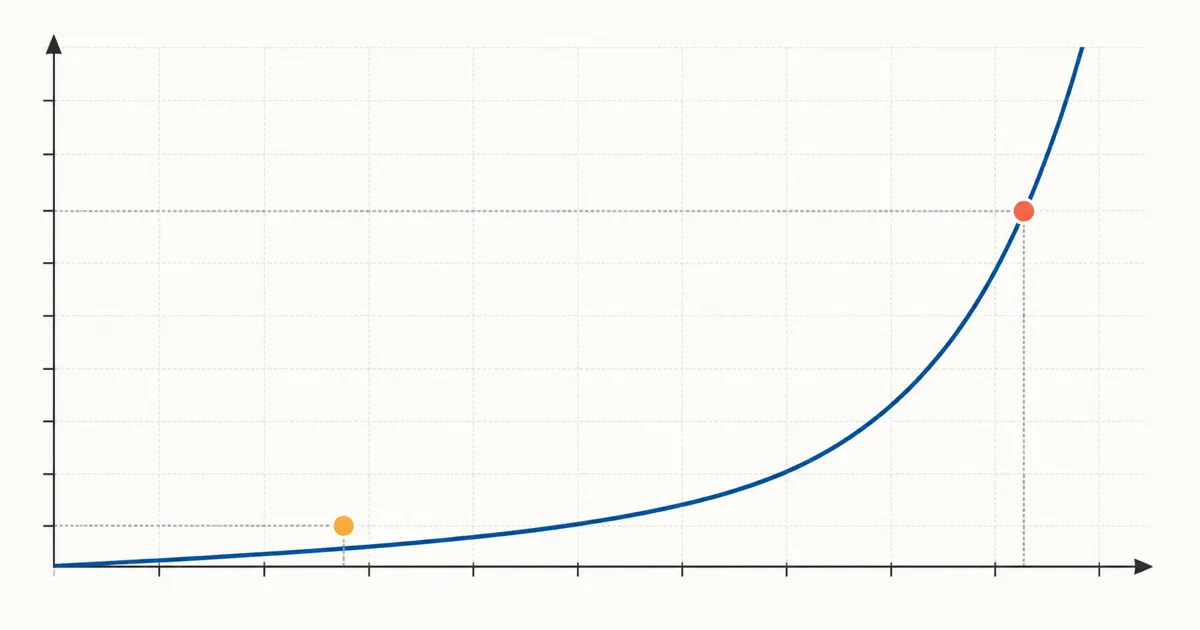
Position Sizing: Why Too Much Risk Can Undermine a Good Strategy
Position sizing determines how much capital you allocate or put at risk on a particular trade relative to your total trading capital.
It’s one of the fundamental components of money management.
Suppose, for example, that two traders use exactly the same strategy and start with the same amount of capital.
Trader A risks 1% of their current capital on each trade.
Trader B risks 10%.
A losing streak will have dramatically different consequences for their accounts.
At 1% risk per trade, after 7 consecutive losses, Trader A would still have about 93% of the initial capital.
At 10% risk per trade, after the same 7 losses, Trader B would have only about 48% left.
The strategy and the sequence of trades are exactly the same. The only thing that changed was the position sizing.
This simple example illustrates a fundamental principle: it’s not enough to have a potentially profitable strategy. You also need to preserve enough capital to keep trading it through the inevitable losing periods.
Don’t Underestimate Losing Streaks
One of the most common mistakes traders make is underestimating how long a losing streak can last.
Having a strategy with a good win rate doesn’t mean winning and losing trades will alternate in a predictable pattern.
Even a strategy that has historically produced more winning trades than losing trades can still experience several consecutive losses.
This is where excessive position sizing can become particularly dangerous.
Andrea gives a very simple example: losing 2% of your capital on one trade may not sound like much. But there can be many losing trades, and those losses add up.
That’s why risk shouldn’t be evaluated by looking at a single trade in isolation. You need to consider the overall behavior of the strategy and the portfolio.
How Much Should You Risk Per Trade?
One of the most common rules in trading is to risk no more than 1-2% of your capital on any single trade.
But even this guideline needs to be interpreted correctly.
Andrea considers 2% per trade to already be a fairly high level of risk.
This isn’t a universal recommendation, since much depends on each trader’s individual risk profile and overall approach. However, once you move above 2%, your trading generally starts to become quite aggressive from a risk standpoint.
This becomes even more important when you’re running multiple strategies or trading multiple markets at the same time.
If several positions are open simultaneously, it’s not enough to consider the risk of each trade separately. You also need to assess your portfolio’s total exposure.
There’s another important distinction to make.
Risking 2% of your capital doesn’t necessarily mean using a 2% stop loss.
For example, if you have $10,000 allocated to trading, risking 2% means structuring the trade so that the expected loss if your stop is hit is no more than approximately $200.
The percentage distance of the stop from the entry price and the percentage of your total capital you’re prepared to lose are therefore two different concepts.
Risk-Reward Ratio Isn’t Enough
Another common rule of thumb in risk management concerns the risk-reward ratio.
You’ll often hear, for example, that a strategy should make at least three times what it risks.
According to Andrea Unger, however, there is no ideal risk-reward ratio that applies to every strategy.
It depends on how the system works.
A trend-following strategy, for example, may generate numerous small losses before eventually capturing a large enough move to offset them. In this case, individual winning trades may be much larger than individual losing trades.
A reversal strategy can have completely different characteristics. It might use a relatively wide stop and a closer profit target, resulting in an average winning trade that is smaller than the average losing trade.
That doesn’t necessarily mean the strategy is ineffective.
If the strategy has a sufficiently high win rate and has been properly developed and tested, its overall results can still be positive.
So when evaluating a strategy, we can’t simply look at how much we make when we’re right versus how much we lose when we’re wrong.
We need to consider its statistical characteristics as a whole.
Also watch this interview with Andrea Unger: Is Trading Risky? How Much Money Do You Need?
The Backtest Trap: The Future May Look Different From the Past
Backtesting is a fundamental tool in systematic trading because it allows us to evaluate how a strategy would have performed on historical data.
But it’s still a simulation of the past.
In the future, a strategy may experience losing streaks that differ from those observed during the period used to develop and test it. Future drawdowns may therefore be larger than those recorded historically.
That’s why it’s dangerous to treat the best results from a backtest as though they represent what will necessarily happen in the future.
Position sizing should leave enough room to withstand less favorable conditions without putting the account at excessive risk.
This principle is particularly important because, as Andrea explains, increasing risk doesn’t lead to an unlimited increase in returns.
For any given strategy, there is a level of risk beyond which increasing exposure further can actually hurt performance.
Risk can therefore be evaluated using the strategy’s historical trade data, while always remembering that past performance is no guarantee of future results.
Risk of Ruin in Trading vs. the Kelly Criterion: Are They the Same Thing?
Risk of ruin in trading and the Kelly Criterion are different concepts, although both relate to capital, risk, and position sizing.
The Kelly Criterion is a mathematical model designed to determine how much capital to allocate based on the probabilities associated with a particular outcome.
The general principle is that the greater the statistical edge, the larger the share of capital that can potentially be allocated.
However, it is generally considered a very aggressive approach and originated in a context more closely related to betting theory than to trading.
It’s also far from the only method available for determining position size.
There are many different approaches, ranging from allocating a fixed percentage of capital or a fixed dollar amount to methods that take volatility or historical drawdown into account.
The key, therefore, isn’t to find a universal formula. It’s to use a position-sizing method that is consistent with the characteristics of your strategy, your capital, and the amount of risk you’re willing to take.
Risk Profile: There Is No One-Size-Fits-All Solution
This brings us to another fundamental consideration: the trader’s individual risk profile.
Not everyone is willing or able to tolerate the same fluctuations in account equity.
Some traders prefer a more aggressive approach and are willing to accept larger drawdowns in exchange for the possibility of higher returns. Others prefer a more conservative approach.
There is no universally correct risk profile.
What matters is understanding your own risk profile and adjusting your trading accordingly.
A trader may consciously decide to risk more than 2% of their capital on a particular trade. But they need to understand that they’re adopting an aggressive approach and be fully aware of the impact a losing streak could have on their account.
Problems arise when the amount of risk being taken exceeds what the trader can realistically withstand, either financially or psychologically.
Risk and Diversification in Systematic Trading
In systematic trading, risk can be defined before entering the market.
This makes it possible to establish in advance how much we’re prepared to lose and, as much as possible, prevent position sizes from being determined by emotions in the heat of the moment.
But risk shouldn’t be considered only at the individual strategy level.
Andrea’s approach involves diversifying across multiple strategies and markets rather than concentrating all available capital in a single position or system.
However, diversification also needs to be evaluated properly.
Running five strategies doesn’t necessarily mean you’re well diversified if all five respond similarly to the same market conditions. Highly correlated systems can enter losing periods at the same time, increasing the overall risk of the portfolio.
Position sizing should therefore be viewed as part of a broader risk management framework that takes into account not only individual trades but also total exposure and the characteristics of the strategies being traded.
Risk Management Comes Before Returns
When evaluating a strategy, it’s natural to focus on potential profits.
But high returns mean very little if achieving them requires taking on so much risk that your ability to continue trading is put in jeopardy.
This is the fundamental principle behind the concept of risk of ruin in trading.
The goal isn’t to eliminate risk – that’s impossible in trading – but to size it consciously and consistently based on your capital, your trading approach, and your individual risk profile.
A good strategy certainly needs sound statistical characteristics. But it also needs to be traded with position sizing that allows the trader to withstand the inevitable losing periods without putting too much of the account at risk.
As Andrea points out with an extreme but very effective example, if you risk all your capital on a single trade, you may make a lot of money if it works out.
But if it doesn’t, you’re done trading.
Frequently Asked Questions About Risk of Ruin in Trading
What is risk of ruin in trading?
Risk of ruin in trading generally refers to the probability that losses will cause your capital to reach a predetermined critical threshold. This threshold doesn’t necessarily mean losing the entire account. It can also represent a drawdown level beyond which continuing to trade becomes extremely difficult or no longer sustainable.
Is risking 2% per trade considered low risk?
Not necessarily. Andrea Unger considers 2% per trade to already represent a fairly high level of risk and points out that going above this threshold generally means adopting a particularly aggressive approach. However, this is a general guideline, not a rule that applies to everyone. Risk should always be evaluated based on your individual risk profile and overall trading approach.
Does risking 2% mean setting a 2% stop loss?
No. These are two different concepts. A 2% risk refers to the potential loss relative to your total capital allocated to trading. A stop loss, on the other hand, defines the distance between your entry price and the price at which the position will be closed. Position sizing allows you to combine these elements so that the potential loss remains within your predetermined risk limit.
Can a profitable strategy still be too risky?
Yes. A strategy may show positive long-term results while still experiencing significant losing streaks and drawdowns. If positions are too large relative to the available capital, these periods can seriously damage the account before the strategy’s statistical edge has enough time to play out.
How is risk of ruin in trading different from maximum drawdown?
Maximum drawdown measures the largest decline from a previous equity peak observed over a given historical period, such as during a backtest. Risk of ruin in trading, on the other hand, refers to the probability of losses reaching a predefined critical threshold in the future. Historical drawdown can be useful when evaluating risk, but it doesn’t guarantee that larger losses won’t occur in the future.
Is there an ideal risk-reward ratio?
No. The risk-reward ratio needs to be evaluated alongside the strategy’s other characteristics. A strategy may have average profits that are much larger than its average losses but a relatively low win rate. Alternatively, its average losses may be larger than its average profits, but a high win rate may compensate for them. What matters is the overall behavior of the strategy, not a single ratio viewed in isolation.