
Switching Trading Strategies: Why Effort Alone Isn’t Enough
Davide
So maybe the real question isn’t whether you should trade, but how you go about it.
And with that, I’d like to invite Andrea up on stage. If you’re backstage and you’d like to join us…
Let’s give Andrea another round of applause. There he is! I thought he’d disappeared back there.
Andrea
I was back here listening to you guys. You can leave that with me.
I’m a little annoyed that he has time to run now, because pretty soon he might beat my personal bests, which I set many years ago. But he’s getting close.
Davide
I’m forty seconds away in the ten K, and a minute away in the half marathon.
Andrea
But I want that ten K on a track, because he runs on the road. That’s different. They never measure those courses right…
Anyway, I think he’ll do it. He’ll do it. It pains me to say it… I need to give him more work!
Anyway, I’m back. My voice isn’t quite what it was on day one, but that’s okay. The microphone helps.
So, here we are. Over the past few days, you’ve seen, we’ve all seen, a lot of things: strategies, ways to trade, portfolios…
And some of you will probably be thinking, “I like this one. That one, a little less.”
I even heard a few comments at the bar. People saying, “Yeah, that one… But that other one? No, come on.” Or the other way around. One thing makes an impression, and another doesn’t quite resonate.
That’s normal. The same thing happens to me. I’m still curious, and I often look into new things to see if there’s anything I can learn. Some make a good impression. Others leave me with questions. That’s perfectly normal.
Most people come to us after trying all kinds of things. Pier and Davide both talked about that in their own way. With discretionary trading, people try different strategies and approaches, and they certainly put in the effort. There’s no question about that. When your own money is on the line, it makes sense to put some effort into it.
What’s usually missing is consistency in the results. And obviously, that doesn’t mean, “I bring home a paycheck every month.”
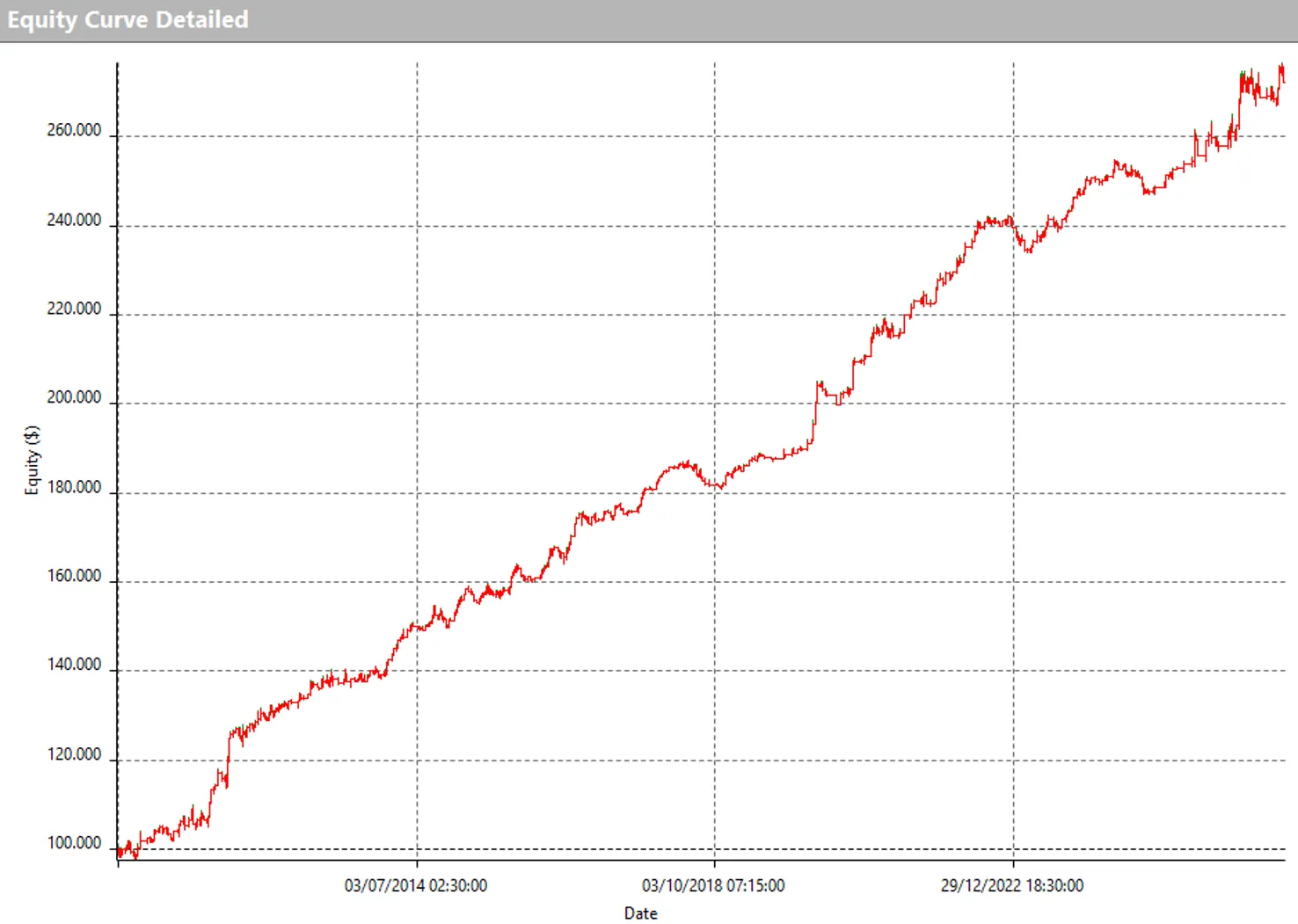
It means seeing something like the equity curve Pierluigi showed us. There were ups and downs, but it moved higher. From beginning to end, it moved higher. An exceptional result, for sure.
So, given that people keep at it and put in the effort, I can’t say they’re unwilling to commit. What’s missing, though, is a structured way of working.
The problem starts when you assume there’s only one way to do this. But there isn’t, and I think you’ve understood that by now.
There are different approaches. We’ve seen them over the past few days, and they’re all valid. We’ve seen the numbers. These are clearly approaches that work well.
The problem is that people usually look at them the way I described earlier: “That one, yes. That one, no.” They see them as alternatives. I can do this instead of that.
In principle, that’s fine. But it’s a little like choosing a road to follow and then staying stuck on it, determined to do nothing else and push all the way to the end.
Choosing a Trading Approach That Fits Your Life
The reality is different. What I tried to explain in my session on the advanced trader’s portfolio is that these approaches, and potentially others, can work together. You can shift between them, and they can evolve over time.
That’s because trading isn’t static. And they told us that themselves just a little while ago.
Trading needs to fit each of our lives. Your lives. Not the other way around.
If you lock yourself into something that doesn’t fit the way you want to live, sooner or later you’ll be unhappy. That’s pretty much what happened to Davide in Formula One. It was great, absolutely amazing, but something was missing.
So trading is what needs to adapt. And we can make that happen with the tools we have.
Anyone who trades for a living knows this especially well. That includes me, but also some of my colleagues. It becomes more important than ever to make sure what you do is manageable within your daily routine and your life.
Building a Trading Framework Beyond a Single Strategy
The key is that you don’t use just one strategy. You need to build a broader system, a working infrastructure. An ecosystem, as people like to call it these days, that brings together several different elements.
You can’t just throw that infrastructure together. But I think we all agree on that. I’ll be the first to say it: I don’t wake up in the morning and put random things together. There’s a specific thought process behind it.
Most people don’t have that structure. Years ago, I didn’t have it either.
So what happens in practice?
You make isolated decisions. You keep changing things… I think all of you have been through that in some way, except perhaps those who haven’t started trading yet.
But maybe even they have held off because they kept changing their minds. They weren’t convinced, so they never got started, and so on.
The problem is that there’s no underlying logic, no clear direction. You’ve picked a road, but you haven’t thought about where you’ll stop, where you’ll have a picnic, or any of those things.
Sooner or later, you pay the price. I think that’s happened to all of us, too. It certainly happened to me in my trading career, so I can speak from experience.
There’s no single path that’s right for everyone. That’s pretty obvious, but I want to say it again because it’s very important.
Everyone has their own starting point. It can be different because we all have different motivations. Then there’s your next step, where you want to go from there, in life as well as in trading.
Today we’re here to talk about trading, which is clearly less important than life itself. But it does play a role, and I assume that’s why we’re here, right?
There is, however, a clear direction. It’s the one you saw yesterday in the advanced trader’s portfolio. You need to develop as a trader.
I deliberately used the term “advanced trader” to describe the professional level you can work toward. But either way, that’s the direction.
I’m not saying you have to become professional traders. Maybe you want to, but that’s not the point. The way you work, the way you think, and the way you organize your trading should follow that same model.
That’s the key to moving forward in this complicated world. Although, really, it’s not all that complicated.
Trading Performance and Stability: Managing Trading Risk Over Time
So it’s not about one strategy. It’s about a system. I don’t mean a trading system. I mean a system for how you work.
And it’s not about an isolated performance. It’s about stability.
The equity curve should trend upward. You don’t want one spike followed by a huge drop. Of course, as long as it ends up in the upper right, it might still be okay. But we don’t know what the journey to get there will look like.
What makes a difference to that journey is stability.
So it’s not about a single result. It’s about keeping risk under control over time.
And you control that risk in several ways. Not just by limiting your exposure, but by analyzing it and understanding how best to combine it across the different approaches available to you.
Combining Futures Trading Systems, Options Strategies, and Commodity Seasonality
Picture this… We’re talking about the approaches we’ve seen here, but you could imagine other pillars on this slide, too.
Here we have futures and trading systems, the options strategies Franz and Davide walked you through, Michael Cook’s approach from yesterday, and then our response to Michael Cook, with our approach to studying commodity seasonality.
Those are some nice pillars. Great colors, too, by the way. I have to say, they did a great job choosing this image.
When everything is going well, which it often does, we’re happy, and everything is calm. When things are going well, all these pillars are stable and solid.
But when something changes in the market, imagine a change in the weather that brings in a storm, any individual approach can run into trouble. And in some exceptional cases, something even worse can happen: it can give way.
The difference becomes clear when you picture this structure across the top, connecting all three pillars.
You might notice that it looks a little like that hotel in Singapore, if you’ve seen it. It rests on three towers, with something like a boat across the top.
It’s solid because it spans all three and connects them, helping them withstand the elements.
If a storm comes, a structure built this way can absorb the impact better.
Each individual pillar is no longer left on its own, at the mercy of events. Or the wind, since we’re talking about the weather. The pillars work together to withstand it.
In practice, each of these elements supports the others. In this case, there are three, and they all support one another.