Welcome back to our regular overview of the trading systems in our portfolio.
Today, we’ll focus on two strategies designed for U.S. stock index futures—one of which is well-known—yet both are far less commonly traded compared to the S&P 500 (@ES) and Nasdaq (@NQ). Specifically, we’re talking about the Dow Jones (@YM) and the S&P 400 MidCap (@EMD), which represents mid-cap companies.
While these markets are less liquid than their larger counterparts, the S&P 500 and Nasdaq, they present unique trading opportunities. Their key advantage? They’re not always highly correlated with the major indices, allowing for greater portfolio diversification.
Strategy #1: Multiday Trend Following on the Dow Jones Futures (@YM)
The first strategy we’re discussing today operates on a 15-minute timeframe and follows a well-known, standard entry model: breakouts of the previous session’s highs and lows.
Once a position is entered, it remains open for a set number of sessions unless the trade hits either the stop loss or the profit target earlier. Additionally, all trades are filtered through proprietary price patterns to refine the strategy’s execution.
.png)
Figure 1 – Example of a trade executed using the multiday trend-following strategy on the Dow Jones futures.
Below, you can see the equity line of the system’s historical performance from 2010 to today. The strategy has shown consistent profitability, with some less profitable years but no extreme drawdowns—even during turbulent market conditions. Notably, 2025 has started off exceptionally strong.
.png)
Figure 2 – Equity curve of the multiday trend-following strategy on the Dow Jones futures.
Below are the key metrics of the strategy, which show a total net profit of $247,785, with a maximum drawdown of $18,515. The average trade value is $229, which is an excellent result for this particular futures contract.
Notably, the long-side performance is significantly stronger compared to the short-side, which is notoriously more challenging to manage across all equity futures.
.png)
Figure 3 – Performance metrics of the multiday trend-following strategy on the Dow Jones futures.
As always, it’s worth noting that this futures contract, like others available on the CME, is also offered in a micro version with a contract size equal to 1/10th of the standard contract. This makes it a more accessible option for traders with smaller portfolios.
Strategy #2: Intraday Trend Following on the S&P 400 MidCap Futures (@EMD)
Let’s move on to the second strategy, which operates on a 5-minute timeframe. This system is unique because it capitalizes on a recurring price pattern in the S&P 400 MidCap future—a concept that, surprisingly, is quite simple to explain.
The core rule is straightforward: if the body of the current bar exceeds the range of the last ten bars, a trade is triggered—either long or short. These entries are exclusively executed during regular trading hours (8:30 AM – 3:15 PM) since this is the only session that ensures adequate liquidity for this future.
.png)
Figure 4 – Example of a trade executed by the intraday trend-following strategy on the S&P 400 MidCap futures.
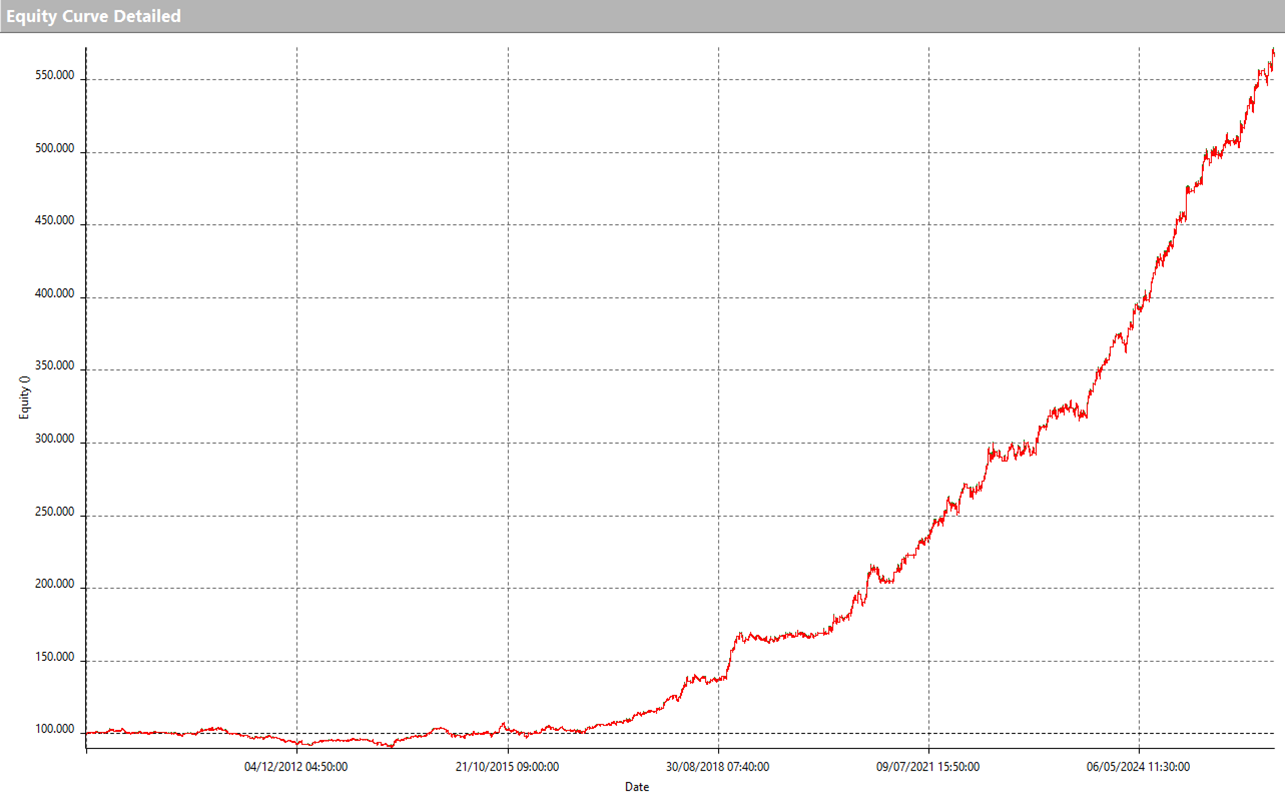
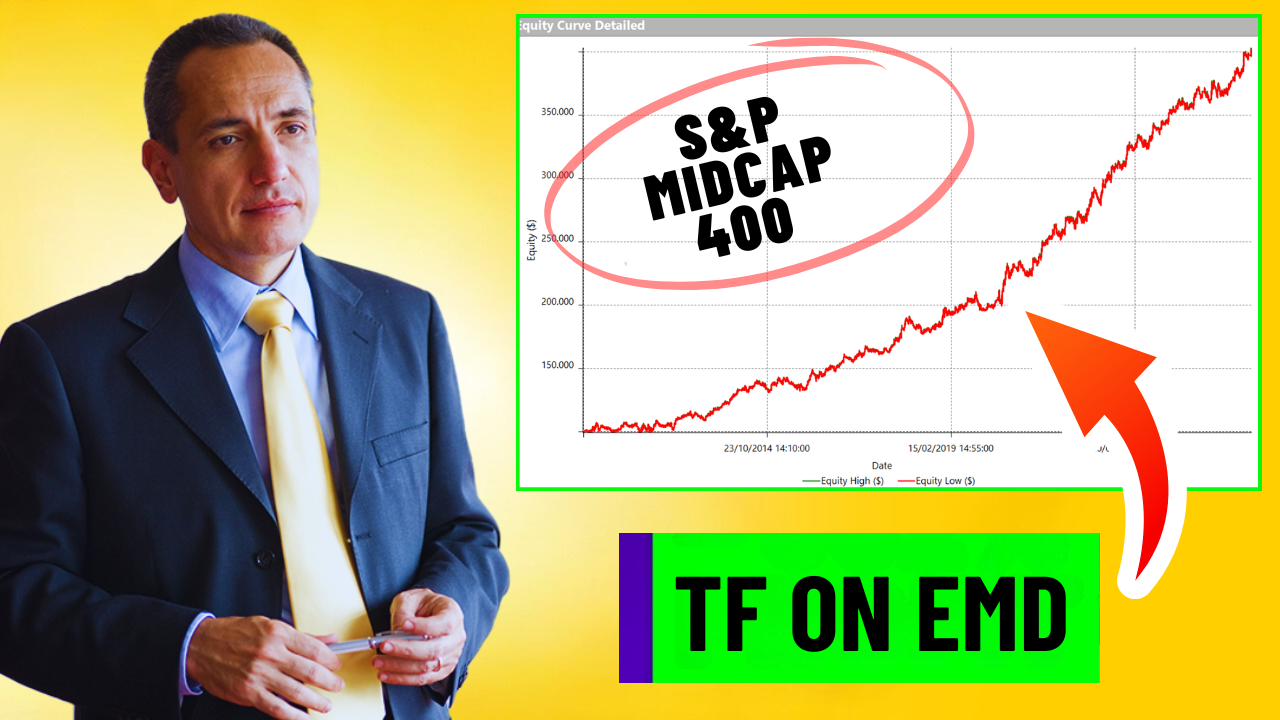
Looking at the Equity Curve Detailed, we see an impressive and highly consistent upward trend, with positive performance in every year except for 2010. Notably, since 2020, net profits have been exceptionally strong, frequently exceeding $30,000 per year, thanks in part to the resurgence of market volatility in recent years.
.png)
Figure 5 – Profit curve of the intraday trend-following strategy on the S&P 400 MidCap futures.
Now, let’s take a closer look at the Strategy Performance Summary and Total Trade Analysis. The strategy has generated a solid net profit of approximately $270,000, with particularly strong performance on the short side. This comes with a moderate maximum drawdown of $16,000, making the risk-reward profile quite appealing.
Additionally, the average trade size of $170 further validates the effectiveness of this system—an excellent result for an intraday trading strategy.
.png)
Figure 6 – Performance metrics of the intraday trend-following strategy on the S&P 400 MidCap futures.
.png)
Figure 7 – Annual profit distribution of the intraday trend-following strategy on the S&P 400 MidCap futures.
Conclusion on the Two Trading Strategies on Dow Jones and S&P 400 MidCap
The two strategies analyzed—one on the Dow Jones futures (@YM) and the other on the S&P 400 MidCap futures (@EMD)—offer compelling opportunities, even though these markets are less liquid compared to major stock indices.
The multiday trend-following strategy on the Dow Jones has shown consistent performance over time, delivering solid net profits while keeping drawdowns under control. Meanwhile, the intraday strategy on the S&P 400 MidCap stands out for its impressive equity curve and strong profitability, particularly in recent years.
These strategies prove that it’s possible to achieve strong results even in less-traded markets, making them valuable considerations for traders seeking diversification and robust trading approaches.
As always, the key is to thoroughly test and fine-tune your systems to align with your portfolio needs.
See you next time, and happy trading!